Record meetings or bring in podcasts, lectures, videos, and YouTube talks. Turn them into searchable knowledge — locally, in minutes.
Your machine. Your models. Your knowledge base.
$ brew install --cask audistill/tap/audistill
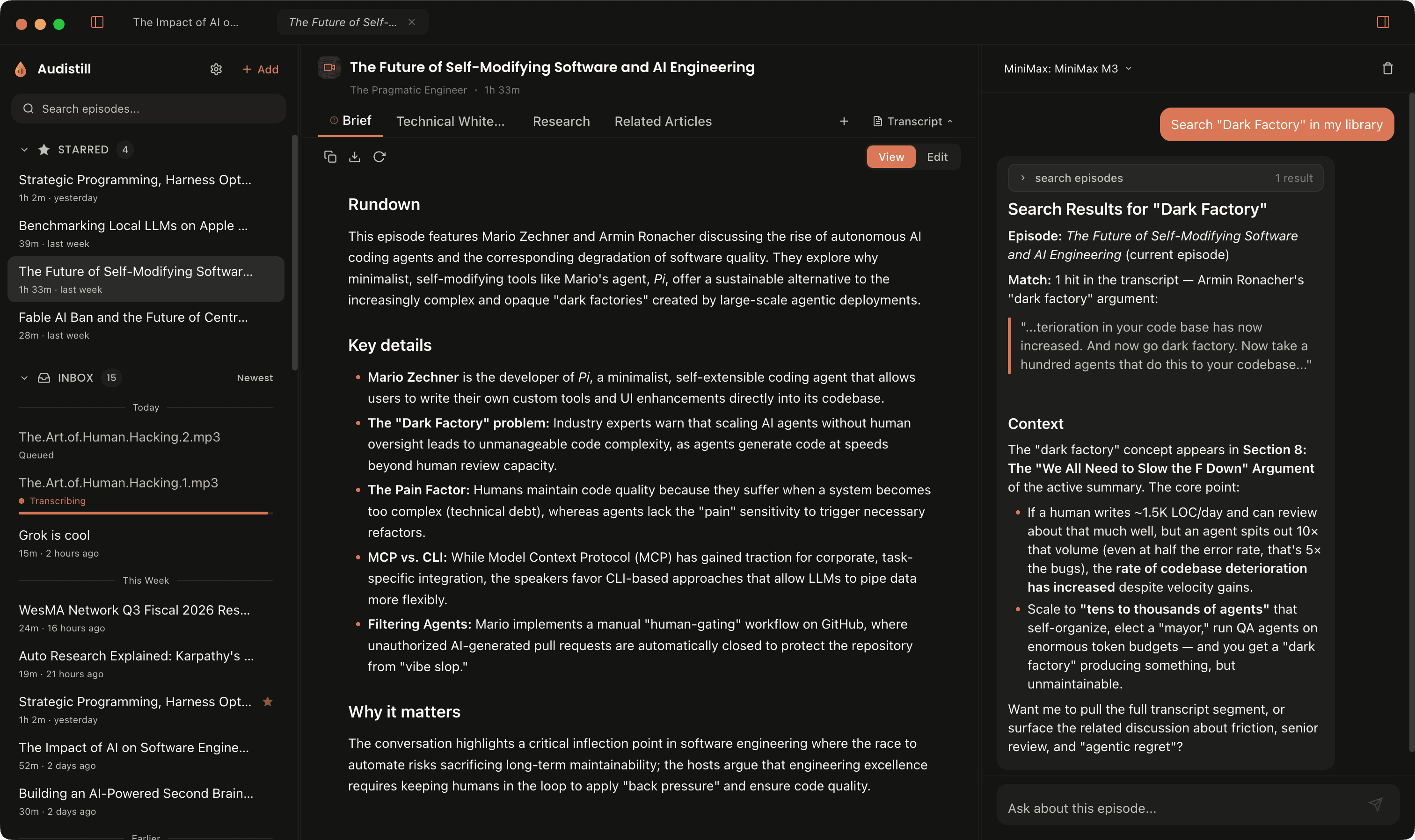
From raw audio or video to searchable knowledge — entirely on your machine.
Audio files, video files, YouTube links, RSS feeds, or any media URL. One input field auto-detects everything.
YouTube import is powered by yt-dlp, a third-party open source project.
30–50× realtime on Apple Silicon
Transcribed on-device in minutes using Parakeet TDT on Apple Silicon. Then summarized, structured, and tagged by any model you choose via OpenRouter.
Media files never leave your machine.
Search across everything. Ask questions. Surface patterns. Generate new content from your knowledge base.
Every tier. Every feature. No upsells.
A research assistant with tools. Search across your library, extract patterns, and generate new content — not just a chatbot.
Find every mention of churn across last month's interviews
3 matches found
Import audio, video, YouTube links, RSS feeds, and direct media URLs. One field, auto-detected.
Capture Mac audio, one microphone, or both. Pause when needed — recording continues while Audistill is hidden or you view another Episode.
30-50x realtime on Apple Silicon. For video files, Audistill extracts the audio track with FFmpeg and transcribes it locally.
Access 200+ models via OpenRouter. Bring your own API key — no markup, no middleman.
Define how content gets shaped. We call them Recipes — run on any transcript.
Find anything across every transcript locally, or let the AI search the web to enrich your results.
Same app. Different workflows. Same result: knowledge you can actually find again.
Paste YouTube links from WWDC, JSConf, Strange Loop — or import the video files directly. Build a searchable library of every talk you watched.
…RSC eliminates the waterfall by moving data fetching to the server…
…server components change how we think about the component tree…
…the mental model shift with RSC is fundamentally about ownership…
↑ found across 6 months of talks
Capture Mac audio and your microphone directly in Audistill. Stop when you're done, and get a Recorded Episode with an on-device Transcript — ready for decisions and action items.
Subscribe to feeds. Auto-ingest. Search across months of listening.
Ingest 15 customer calls. Ask one question across all of them. See what actually keeps coming up — not what you assumed.
Run different Recipes on the same 90-minute recording. Brief for review, detailed for study, key quotes for your paper.
The lecture introduces three competing models of attention allocation in cognitive load theory, with emphasis on the redundancy effect.
Key distinction: intrinsic vs. extraneous load — the speaker argues most instructional design failures are extraneous.
Actionable takeaway: chunk information into 3–5 segments before testing recall.
Every tier includes all features. Forever.
The only difference is how many Macs you own.
No. Transcription runs entirely on your Mac using Apple Silicon. Media files never leave your machine. AI features (summaries, chat, web search) use your OpenRouter API key — calls go directly from your Mac to the model you choose.
Yes. Choose Add → Record audio or press Command–Shift–R. Capture Mac System Audio, one selected built-in, Bluetooth, or USB microphone, or both. You can pause, hide or minimize Audistill, and view another Episode without stopping the session. Stop and process creates a Recorded Episode through the usual on-device Transcription and Ingest flow. The recording audio is temporary — it is deleted after the Transcript is stored, so Audistill is not a permanent playback library. macOS requests Screen Recording access for System Audio and Microphone access for your microphone.
Audistill supports audio files like .mp3, .m4a, .wav, .flac, .aac, .ogg, and .opus, plus video files like .mp4, .mov, .mkv, and .webm for transcription. Video is used as an audio source only — no video playback or visual analysis. You can also import YouTube links and direct media URLs. If a video has no audio track, Audistill will tell you.
“Your media files never leave your machine. Transcription happens entirely on-device.”
Audistill connects to LLMs via OpenRouter. You provide your own OpenRouter API key and pick from 200+ models for summaries and chat. Typical cost: a few cents per episode. We never see your key or your data.
Audistill includes full-text search across all your transcripts and generated documents. The AI assistant can also perform web-based search to enrich answers with up-to-date information from the internet.
The app remains viewable — you can browse your library, read transcripts, and search. Ingest, chat, and recipe execution require a license to continue.
No. One-time purchase, lifetime updates. Pick the tier that matches how many Macs you own.
Any Mac with Apple Silicon (M1 or later). macOS 13 Ventura or newer. Intel Macs are not supported.
The source code is available. You can build and run it yourself. The paid download gives you a signed, notarized binary with auto-updates and supports continued development.
Audistill is fully open source. Inspect, modify, contribute —
your tool, your rules.
Main repository
14 days free. No credit card. Pick your path.
Signed & notarized .dmg
One-click install. Auto-updates. Supports development.
Download for MacFor terminal lovers
Install and update via Homebrew Cask. Same signed binary.
$ brew install --cask audistill/tap/audistillFull control
Clone, inspect, build. Free forever. No telemetry, no limits.
View on GitHub